Cart
0


The Story Behind Every Thread
One Garment. Hundreds of Hands.


When you hold a garment in your hands, it's easy to see the fabric.
What you don't see are the hundreds of hands that quietly brought it to life."
Every piece of clothing has a beginning.
Not in a boutique.
Not in a factory.
Not on a clothing rack.
Its journey begins in a field.
Long before it becomes a kurta, a dress, or a saree, it begins as a tiny cotton seed planted into the earth by someone who may never know the woman who will eventually wear it.
At House of Sumegha, we believe every garment deserves to have its story told.
Because behind every thread lies patience.
Behind every stitch lies craftsmanship.
And behind every finished piece lies the work of countless people whose names may never appear on a label—but whose dedication lives within every garment.
It Begins With a Farmer
Before there is fabric, there is hope.
Months before cotton reaches a loom, a farmer prepares the land.
The soil is tilled.
Seeds are carefully planted.
The first rains are awaited with quiet anticipation.
For weeks, and then months, the fields demand constant attention. The crops must be protected from pests, nourished through changing weather, and patiently cared for until the fluffy white cotton bolls are ready for harvest.
Every season is different.
Some years bring generous rainfall.
Others test the resilience of the people who depend on the land.
Yet, year after year, cotton farmers continue their work with remarkable perseverance.
Their hands are the first to touch the fibres that will one day become clothing.
Without them, there is no beginning.
From Cotton to Fibre


Freshly harvested cotton is soft, but it isn't ready to become fabric.
Each cotton boll contains seeds that must be carefully separated from the delicate fibres. This process, known as ginning, cleans the cotton and prepares it for the next stage of its journey.
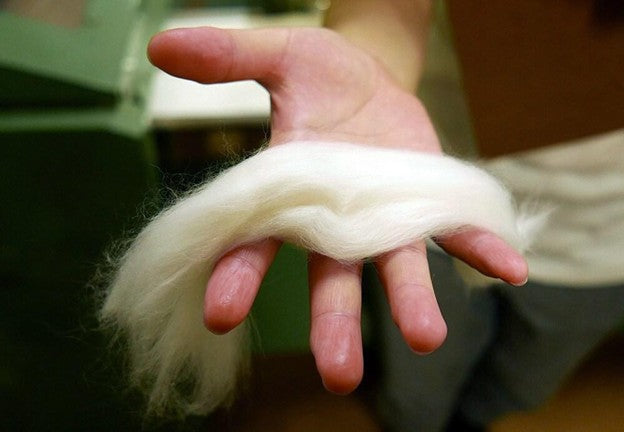
The cleaned fibres are then fluffed, aligned, and transformed into long, continuous strands. At this point, the cotton is no longer simply a crop—it has become the foundation of every future thread.
What seems like a simple transformation is the result of careful processing, where preserving the strength and quality of the fibre is just as important as removing impurities.
A Single Thread Begins to Form
The soft cotton fibres now begin another remarkable transformation.
They are gently drawn out, twisted together, and spun into yarn.
For generations, this was done entirely by hand.
Today, depending on the weaving tradition, spinning may still involve hand-spun techniques—as in Khadi—or carefully controlled mechanical spinning that preserves the strength and quality of the yarn.
Every thread must have the right balance.
Too loose, and it breaks.
Too tight, and it loses flexibility.
The strength of the final fabric depends greatly on the quality of this yarn.
Long before anyone notices the beauty of a garment, the thread has already determined much of its future.
Colour Before Cloth


Before the loom begins its rhythm, colour enters the story.
Depending on the textile tradition, yarn may be dyed before weaving or fabric may be dyed after it is woven.
Some artisans continue to use age-old dyeing techniques passed down through generations, while others combine traditional craftsmanship with modern methods that ensure colour consistency and longevity.
Each bundle of yarn absorbs colour differently.
The weather matters.
The water matters.
The drying time matters.
The artisan watches carefully because every shade will eventually become part of the finished garment.
What appears to us as a beautiful colour is, in reality, the result of experience, patience, and countless small decisions.
The Weaver's Hands


This is where thread becomes fabric.
For many, weaving is more than a profession.
It is a family tradition that has been passed from one generation to the next.
A handloom does not move by itself.
Every thread is guided by the rhythm of the weaver's hands and feet.
The shuttle moves.
The reed beats the threads into place.
The pedals lift and lower the warp.
Hour after hour.
Day after day.
Unlike machine-made textiles, handloom weaving cannot be rushed.
The artisan constantly adjusts the tension, watches every thread, and corrects tiny imperfections as the fabric slowly grows.
Sometimes, a single saree or several metres of intricate fabric can take days to complete.
Every metre represents hours of concentration and years of experience.
This is why no two handloom fabrics are ever exactly alike.
Each one carries the quiet signature of the person who created it.
Designing With Intention
Beautiful fabric alone does not create beautiful clothing.
It must first be understood.
At House of Sumegha, every fabric is carefully considered before it becomes a garment.
We ask ourselves:
How will it move?
How will it feel after many washes?
Will it remain comfortable during a busy day?
Can it become a piece someone reaches for again and again?
Our designs are guided not by passing trends but by the belief that clothing should become part of everyday life.
Every silhouette is created to honour the fabric rather than overpower it.
The Tailor's Craft


Once the design is finalised, the fabric reaches another pair of skilled hands.
The tailor.
Every panel is measured with precision.
Every pattern is carefully placed to minimise fabric waste.
Each seam, pleat, sleeve, and neckline requires patience and accuracy.
A beautifully stitched garment is one where the craftsmanship almost disappears.
Nothing feels forced.
Nothing distracts.
Everything simply fits together naturally.
It is the tailor's quiet expertise that transforms beautiful fabric into clothing that moves effortlessly with the body.
The Final Inspection
Before a garment reaches its new home, it is carefully checked.
Loose threads are removed.
Measurements are verified.
Buttons are inspected.
Seams are examined.
The fabric is checked once again for any imperfections.
These final moments may seem small, but they reflect a simple belief:
Every customer deserves to receive a garment we are proud to send.
Wrapped With Care
Packaging is often the first physical interaction a customer has with a brand.
For us, it is an extension of the garment itself.
We choose packaging that protects your order while reflecting our commitment to thoughtful design and responsible choices. Every fold, every label, and every detail is prepared with the hope that opening your parcel feels calm, personal, and special.
It is our way of saying, "This was made with care, and we hope it becomes part of your story."
Finally, It Finds You
The journey that began months ago in a cotton field now reaches your doorstep.
You unfold the garment.
You feel the texture.
You notice the crispness of authentic cotton.
You try it on.
And in that moment, the work of farmers, spinners, dyers, weavers, designers, tailors, quality inspectors, and packers comes together in a single piece of clothing.
Most of them will never know your name.
You may never know theirs.
Yet, for a brief moment, your stories become connected through something as simple as what you choose to wear.
More Than Clothing
At House of Sumegha, we don't see garments as products.
We see them as journeys.
Every piece carries the dedication of people who believe in honest work, traditional craftsmanship, and the quiet beauty of creating something that lasts.
When you choose one of our garments, you're not simply adding another outfit to your wardrobe. You're supporting a chain of skilled hands, preserving India's textile heritage, and embracing a slower, more thoughtful way of dressing.
Because a garment is never made by one person alone.
It begins with a farmer who trusts the seasons.
It continues with artisans who honour generations of knowledge.
It is shaped by designers and tailors who work with care.
And finally, it becomes complete only when it finds its place with you.
One garment.
Hundreds of hands.
One shared story.